Lantana: A Modern Calligraphy Font for Handmade Brands
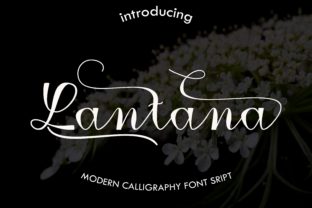
As someone who hand-labels small-batch candles, designs wedding invites for local couples, and sells printable planner pages on Etsy, I know how much a single font can shape the entire feel—and sales—of a product. That’s why Lantana has become my go-to modern calligraphy font. Created by hand by Imun Studio, it’s not just another Script Handwritten typeface—it’s a carefully balanced blend of elegance and approachability, with the warmth of real ink on paper and the polish needed for professional use.
Lantana feels like handwriting you’d want to keep forever: fluid but controlled, expressive but legible. Its letterforms have subtle contrast and graceful entry/exit strokes that give movement without sacrificing clarity. Unlike some ornate script fonts that vanish at small sizes or blur in print, Lantana holds its shape beautifully—even at 10pt on a tea towel tag or 14pt on a kraft paper sticker. It’s designed as a display font first, yes, but its thoughtful spacing and open counters make it surprisingly versatile for short phrases, names, titles, and even light body text in invitations or digital printables.
I’ve used Lantana across so many physical and digital products: lavender-scented candle labels where “Lavender Dream” curves gently around the jar; farmhouse-style wooden signs with “Gather Here” in soft charcoal ink; wedding welcome boards where “Sarah & James” flows like a ribbon across reclaimed wood; and holiday gift tags stamped with “Hand-poured • Made with Love.” It works equally well on matte stickers, glossy product packaging, SVG-cut vinyl decals for mugs and totes, and clean digital templates for Canva or Silhouette Studio.
What makes Lantana especially practical for crafters is how it reads *in context*. On Cricut Design Space, it cuts cleanly at 18mm+ height—no tangled loops or fragile terminals. For smaller applications like seed packet labels or boutique soap tags, I stick to uppercase words or short two-word phrases (“Sweet Pea,” “Honeycomb”) and avoid overloading swashes. The font includes stylistic alternates and ligatures (like the elegant “&” and connected “th” and “st”), which add polish without extra design work—perfect when you’re batch-producing 50 wedding place cards before lunch.
Readability matters most when your customer sees your product for the first time. Lantana doesn’t sacrifice legibility for flair. Its lowercase “a,” “g,” and “e” are distinct and friendly—not cryptic or overly stylized. That means no one squints at your Etsy listing mockup, no guest misreads their name on a seating chart, and no boutique buyer hesitates because the font feels “too hard to read.” In fact, customers often comment on how “inviting” and “thoughtful” my branding looks—proof that good typography quietly builds trust and perceived quality.
For brand consistency, Lantana pairs effortlessly with clean, grounded companions. I almost always pair it with a warm sans serif—think Montserrat Light or Poppins Regular—for body text, pricing, or ingredient lists. That contrast gives handmade labels and packaging both personality and professionalism. When designing seasonal collections—say, spring botanical prints or cozy fall SVG bundles—I’ll sometimes layer Lantana over a soft serif like Playfair Display for headings, letting the script carry emotion while the serif grounds the layout. It’s not about matching styles—it’s about creating harmony between voice and function.
The file package includes OTF and TTF formats, full multilingual support (including extended Latin characters), and OpenType features you’ll actually use: discretionary ligatures, contextual alternates, and a full set of swashes for those special moments—like a flourish under “Est. 2022” on a shop banner or an elegant underline beneath “Thank You” on a printable thank-you card. No need to hunt for separate swash files or install five different variants. Everything lives neatly in one premium font family.
If you sell physical goods—hand-poured soy candles, embroidered linen napkins, ceramic mugs—you’ll appreciate that Lantana comes with a commercial license covering all standard craft and small business uses. That means you can embed it in printable PDFs, convert it to vector paths for SVG designs, use it on product labels and packaging, and even apply it to merchandise like shirts and tote bags—no extra fees or restrictions. Just be sure to check the license terms for client work or large-scale distribution (e.g., white-labeling for retailers), since usage tiers vary by vendor.
One thing I love about using Lantana consistently across my shop is how it strengthens recognition. Customers start to associate that smooth, confident flow with my brand—whether they see it on an Instagram story graphic, a printed recipe card inside a gift box, or a chalkboard sign at my local farmers’ market stall. That kind of visual continuity isn’t accidental. It’s what happens when you choose a Script Handwritten font built for real-world making—not just pretty previews.
Whether you're sketching ideas in a notebook or prepping final files for print-on-demand, Lantana feels like a collaborator—not a decoration. It supports your message instead of competing with it. And in a marketplace crowded with generic fonts and AI-generated scripts, that authenticity makes all the difference. It’s the kind of Fonts investment that pays off in repeat buyers, heartfelt reviews, and the quiet confidence that your work looks exactly how you imagined it—only better.